

The Fourth Sunday of Easter, April 26, 2026
The Fourth Sunday of Easter, April 26, 2026
The Narrative Lectionary – NL442
Acts 16:16-34 – (Luke 6:18-19, 22-23)
Paul and Silas in prison at Philippi, jailor and family baptized.
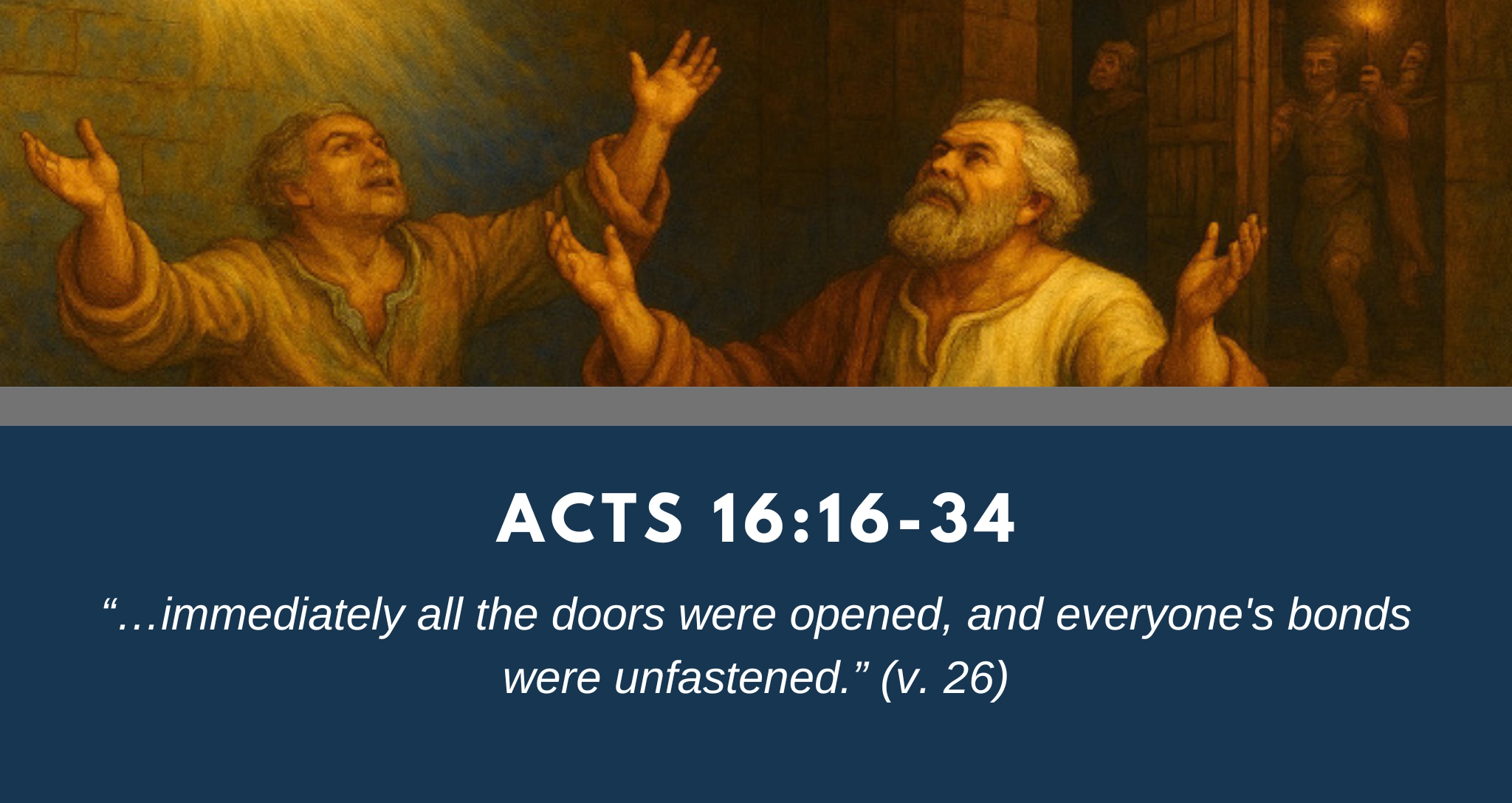
“…immediately all the doors were opened, and everyone’s bonds were unfastened.” (Acts 16:26)
The gospel goes to Europe via the city of Philippi. The story features three characters: a demon-possessed slave girl, the apostles Paul and Silas, and a Roman jailer. The account demonstrates how the proclaimed Word of Christ confronts bondage in its many forms: spiritual, economic, legal, and existential. The text exemplifies the sharp distinction between Law and Gospel. The Law accuses, strips, and kills the old Adam; the Gospel creates faith, frees, and gives life where death once reigned.
The passage opens with the slave girl (vv. 16-18). She is twice bound, once to her human owners who profit from her “spirit of divination” and again to the demonic power itself. Ironically, her cries ring true: “These men are servants of the Most High God, who proclaim to you the way of salvation” (v. 17). Yet Paul is annoyed by her cries. He commands the spirit out “in the name of Jesus Christ” (v. 18). The exorcism is instantaneous and total. The name of Jesus has authority over demonic forces. The liberation, though, comes at a cost. The girl’s owners lose their income. That loss exposes the economic idolatry intertwined with spiritual oppression. The old Adam exploits others to maintain control—whether through greed, power, or false religion.
The owners subject Paul and Silas to the Law (vv. 19-24), dragging them before the magistrates, and stirring the crowd with charges laced with anti-Jewish prejudice: “These men are Jews, and they are disturbing our city. They advocate customs that are not lawful for us Romans to accept or practice” (vv. 20-21). With undue haste, the apostles are stripped, beaten with rods, and thrown into the inner prison bound in stocks. The Law reveals itself: it accuses, exposes, and punishes.
Philippi, proud of its Roman status, enforces civic order through the violence of physical coercion. The apostles suffer not for wrongdoing but because their preaching threatens the status quo. Their imprisonment mirrors the cross—innocent suffering under imperial and religious powers. Yet Luke emphasizes their response: at midnight, Paul and Silas pray and sing hymns, and the prisoners listen (v. 25). They are indeed theologians of the cross. Freedom is not escape from suffering but trusting God in the midst of it. While the old Adam demands control and vindication; the new creation sings where the world expects despair.
The earthquake (vv. 26-28) shakes things up. Foundations crumble, doors fly open, and chains loosen for all. The jailer wakes and thinks he’s failed his duty and prepares to fall on his sword. Roman law demanded the death penalty for escaped prisoners. He embodies the Law’s final demand: blood must be paid. But Paul cries out, “Do not harm yourself, for we are all here!” (v. 28). The jailer asks a fear-filled question: “Sirs, what must I do to be saved?” (v. 30). This cry echoes throughout Scripture—the rich young ruler (Matt 19:16), the Pentecost crowd (Acts 2:37), among others. It is the voice of the terrified conscience under the Law’s verdict: guilty, condemned, helpless.
Paul and Silas offer no new law, no checklist, no self-improvement program. Their answer is pure Gospel: “Believe in the Lord Jesus, and you will be saved, you and your household” (v. 31). The Word is spoken to the entire household (v. 32). The jailer washes their wounds, and baptism follows immediately (v. 33). The prison becomes a church; fear turns to joy as they share a meal (v. 34). The Gospel does what the Law cannot: it creates faith ex nihilo–out of nothing, buries the old Adam, and raises the new creature. Salvation is not achieved but received. The earthquake is not merely physical but also cosmic. Christ’s death and resurrection turned the religious landscape upside down (cf. Isaiah 40:3-5 & Luke 1:46-55), opening for all their prison doors of sin and death.
The gospel is for all people. It reaches the exploited slave, the beaten missionaries, the despairing jailer, and his family. It delivers true freedom, liberating its hearers from sin, death, and the devil through faith alone in Christ alone.
The gospel promise resounds: the same Lord Jesus who cast out the demon, who sustained singing in stocks, who shook the prison, and who spared the jailer’s life now speaks directly to you. “Believe in the Lord Jesus, and you will be saved—you and your household.” No chains of guilt, no demands of performance, no fear of final judgment can hold you. The earthquake has already happened at Calvary and the empty tomb. Your prison doors stand open. The Word creates faith that receives full forgiveness, new life, and eternal life. Come to the waters of baptism, the table of the Lord, and the preaching of this promise. You are free—truly free—in Christ. “Believe it, and you have it!”
Table Talk: Discuss the upset caused by the earthquake in the context of Isaiah chapter forty and Mary’s Magnificat in Luke 1.
Pray: Heavenly Father, put your Good News in my ears. Amen