

The Third Sunday of Easter, April 19, 2026
The Third Sunday of Easter, April 19, 2026
The Narrative Lectionary – NL441
Acts 9:1-19a – (Matthew 6:24)
Paul and Ananias, each called into Christ’s service.
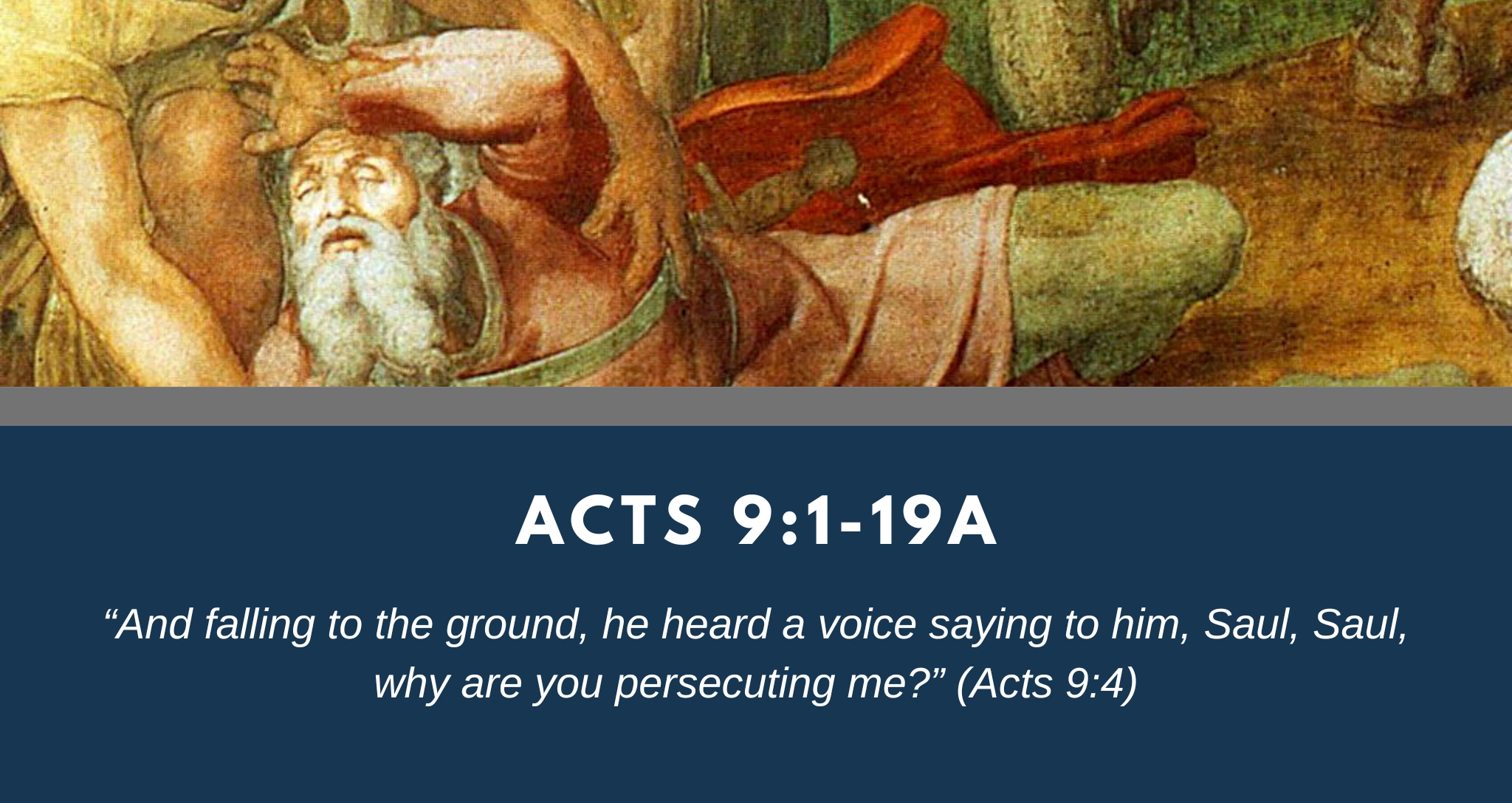
“And falling to the ground, he heard a voice saying to him, Saul, Saul, why are you persecuting me?” (Acts 9:4)
In this text, Luke presents the dramatic reversal of Saul of Tarsus—not as a story of human decision or gradual spiritual growth, but as the total, unilateral invasion of the crucified and risen Christ into a life utterly dead in religious zeal. God’s Word, Jesus Christ, confronts Saul and has its way with him. This is the first distinction of Law and Gospel: God’s Word kills and makes alive (Dt. 32:39). It brings the death of the old being and the creation of the new ex nihilo—out of nothing. God alone works this… God alone acts… The Law slays, the Gospel raises, and the external Word and Sacrament deliver everything.
Saul enters the scene “breathing threats and murder against the disciples of the Lord” (v. 1). He is no secular skeptic; he is the epitome of the old Adam at his most pious. Armed with letters from the high priest, he embodies the theologian of glory, the religious project of self-justification through law-keeping, zeal, and violence against anything that threatens it. Saul is not seeking God; he is hunting those who claim a crucified Messiah has already fulfilled the Law. His journey to Damascus displays the old self in full stride, confident in its own righteousness (cf. Phi. 3:4-6). This is the universal human condition: every sinner, even (especially) a devout one, is an active enemy of the living God.
But… God lies in wait! He ambushes Saul. “Suddenly a light from heaven shone around him” (v. 3). Jesus does not wait for Saul’s consent or offer an invitation. He confronts this pious sinner: “Saul, Saul, why are you persecuting me?” (v. 4). This confrontation delivers the Law in its most radical form—not a gentle nudge, but a killing blow. Luther puts it this way in his Antinomian Disputations: Paul is first “thrown down by the law” before he is raised by the Gospel. The voice does not debate Saul, seeking his intellectual assent, nor does it appeal to a decision of Saul’s free will. The voice identifies Saul’s crusade against the church as an attack on Christ Himself. The old Saul is exposed, condemned, and rendered helpless. He is stripped of agency. He falls to the ground. Three days of blindness follow (vv. 8-9)—a living death. No self-help, no decision for Jesus, no “sinner’s prayer.” The old being must die completely. Saul’s being struck down is no repair job on the religiously minded; it is an execution and a resurrection.
In Damascus, the Lord sends Ananias, a seemingly insignificant disciple, to this terrorist (vv. 10-17). Here, we can rejoice. God works by sending a neighbor… a neighbor who speaks an external Word. This work lies entirely outside of yourself and doesn’t turn you to inner experience or heroic piety. Ananias lays hands on Saul and declares, “Brother Saul, the Lord Jesus who appeared to you on the road by which you came has sent me so that you may regain your sight and be filled with the Holy Spirit” (v. 17). Scales fall from Saul’s eyes. He rises and is baptized (v. 18). Baptism is no mere symbol or human response; it is the sacramental Gospel in action, drowning the old Saul (death) and raising the new Paul (new life) (cf. Romans 6:3-4). In the Word and water of baptism, God puts to death and makes alive. Faith is not Saul’s achievement; it is created by the Word that comes from outside him. The Holy Spirit is given through this tangible, objective means—a pure gift. It is simply received, not achieved.
The text ends with Saul eating, regaining strength, and immediately proclaiming Jesus as the Son of God (v. 20, though the lectionary stops at 19a). He is now God’s “chosen instrument” (v. 15), but one who “must suffer for the sake of my name” (v. 16). Saul the zealot has become Paul, the theologian of the cross. The former persecutor will now be persecuted. Strength is perfected in weakness. We cannot put a gloss of glory on this: Paul’s apostleship is not a promotion but a lifelong participation in Christ’s crucifixion (Gal. 6:14).
For those with ears to hear, our text proclaims the same reality. Your establishment in faith—whether dramatic or quiet—is never your story of deciding for God. It is always God’s story of deciding for you, killing the old Adam… putting to death the old Eve… and raising the new creature through the external Word and Sacrament. “Why are you persecuting me?” still sounds as the Law’s full-throated roar wherever self-justification reigns. And the Gospel still answers: “Rise and be baptized and have your sins washed away” (Acts 22:16). In this text, the one who has ears to hear can hear the heartbeat of the Reformation: salvation by grace alone, through faith alone, delivered by Word and Sacrament alone, to the glory of God alone. Such a hearing justifies the God who saves by putting sinners to death and raising them in Christ to new life.
Table Talk: Discuss why we rejoice that God answers prayer by sending a neighbor and that God works through external means.
Pray: Heavenly Father, send me a neighbor who will be my preacher. One who will declare to me your Law and your Gospel that I would be justified. Amen